The world probably doesn't need another videogame console.
There are already incredible machines capable of doing things we couldn't have imagined when we first started playing games.
More power.
Better graphics.
Bigger worlds.
Thousands of games available instantly.
And yet, we miss something.
Not the software.
The thing.
The box you picked up from a shelf.
The artwork you stared at on the way home.
Opening it.
Reading the back.
Looking through the manual.
Taking out the cartridge.
Putting it into the machine.
Power on.
Play.
We don't want to go backwards.
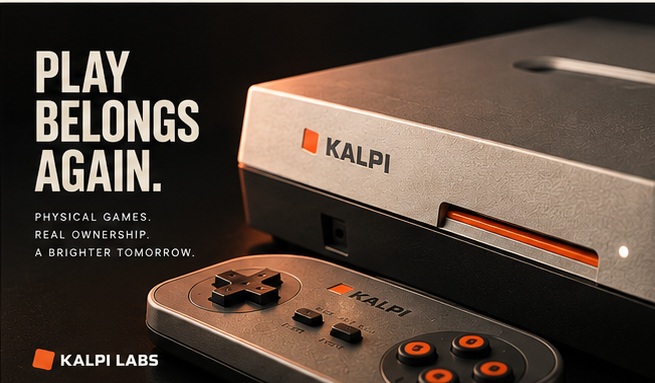
Kalpi isn't about pretending it's 1994 again.
We love old videogame systems, but we're not interested in building another retro console or another box full of emulators.
We're interested in a question:
What if we took some of the things we lost and designed a new videogame system around them?
Physical games.
Real ownership.
Simple hardware.
Independent developers.
Playing together in the same room.
No nostalgia required.
What if buying a game meant owning it?
This is one of the simplest ideas behind Kalpi.
You buy a cartridge. It's yours.
Play it.
Keep it.
Take it to a friend's house.
Lend it to someone.
Give it to your kid twenty years later.
Sell it.
Put it on a shelf and forget about it for ten years.
Then find it again, put it into the console and play.
No account should have to remember that you bought it.
No authentication server should need to give you permission.
What if a console didn't need to know who you are?
Turn it on.
Put in a cartridge.
Pick up a controller.
Play.
That's it.
We don't think every object in our lives needs an account.
Kalpi shouldn't care about your email address.
Your friend shouldn't need to create a profile before joining.
If four people are sitting on a sofa with four controllers, joining the game should be as complicated as:
What if indie developers could make something you can hold?
This might actually be the bigger experiment.
Today, an independent developer can make an extraordinary game and distribute it to the entire world.
That's amazing.
But making a physical game is different.
Manufacturing.
Packaging.
Minimum orders.
Distribution.
Hardware compatibility.
Logistics.
Cost.
For a small developer, all of that can quickly become unrealistic.
We want to explore whether Kalpi can make the process simpler.
Imagine making your game and eventually being able to say:
Not download codes. Not keys.
50 cartridges.
Your game.
Your artwork.
Your box.
Something real that you can sell, sign, give away, number or keep.
That's one of the things we want to figure out.
And what happens when a physical game has a bug?
This question came up almost immediately.
Our first instinct was:
And we still believe in that.
But software isn't perfect.
Testing matters, and games should be properly tested before manufacturing. Still, it's unrealistic to pretend nobody will ever discover a bug after a cartridge exists.
So we're exploring a different idea.
Physical releases.
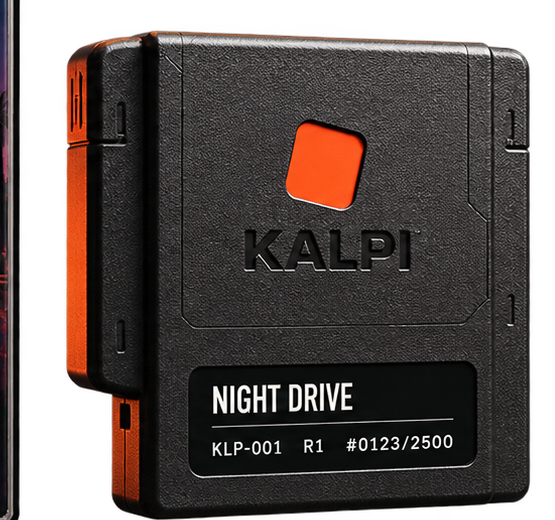
Imagine a fictional Kalpi game: NIGHT DRIVER.
Its first physical run could be:
KLP-027 identifies the game.
R1 means Release 1.
#0187/0250 means this is physical copy 187 of a 250-copy run.
Six months later, players discover an issue.
We don't silently change those cartridges. R1 remains R1.
The issue is documented publicly. The developer fixes it. The corrected game is tested and mastered again.
And future cartridges become:
No patch replaces R1.
No server changes what is sitting on your shelf.
R1 and R2 become part of the history of that game, like different pressings of a record or different editions of a book.

Players can help document that history.
Every Kalpi game could eventually have its own page.
Not just screenshots and a Buy button. Its actual physical history.
R1 — 250 copies
R2 — 500 copies
What was discovered. Which releases are affected. Whether there's a workaround. Which later release corrected it.
If somebody discovers something strange while playing, they can report it.
Kalpi and the developer can investigate it. If confirmed, it becomes part of the documented history of that physical release.
We think transparency is more interesting than pretending software is perfect.
Every game should look like itself.
We've also started thinking about what a shelf full of Kalpi games might look like.
We don't want every developer to make a game that looks like us. Quite the opposite.
A developer should be free to create a bizarre pixel-art game, a hand-painted adventure, a low-poly racer or something we've never seen before.
Their artwork should belong to them.
Kalpi provides the physical system around it: the box, information hierarchy, spine, catalog number, release information and cartridge format.
So twenty completely different games can sit next to each other and somehow still look like they belong to the same library.
Kalpi brings the system.
We're building Kalpi from the cartridge out.
The principles are clear.
The physical game comes first.
The cartridge is the game.
The console should be simple, immediate and built around ownership.
What we're working through now is the exact way to make that real.
Cartridge architecture.
Save storage.
Console hardware.
Manufacturing.
Developer tools.
Physical publishing.
Those are not reasons to wait before talking about Kalpi. They're the work of building Kalpi.
Kalpi Labs is where that work happens.
We'll share the experiments, prototypes, failures, manufacturing tests and decisions as the system takes shape.
Not because the product is vague, but because we think the process of making a physical videogame platform should be visible.
physical again.
Kalpi Labs
Built slowly. Built in public.